Read and then take the quiz!
〰️
Read and then take the quiz! 〰️
Where It All Began
Before we gather around the table, it’s important to know a little about the game that brought us here.
Mahjong developed in China in the mid-to-late 1800s, likely in the area around Shanghai. Its roots can be traced to earlier Chinese card games in which players drew and discarded cards while trying to create matching sets. Over time, cards gave way to the familiar tiles that define the game today.
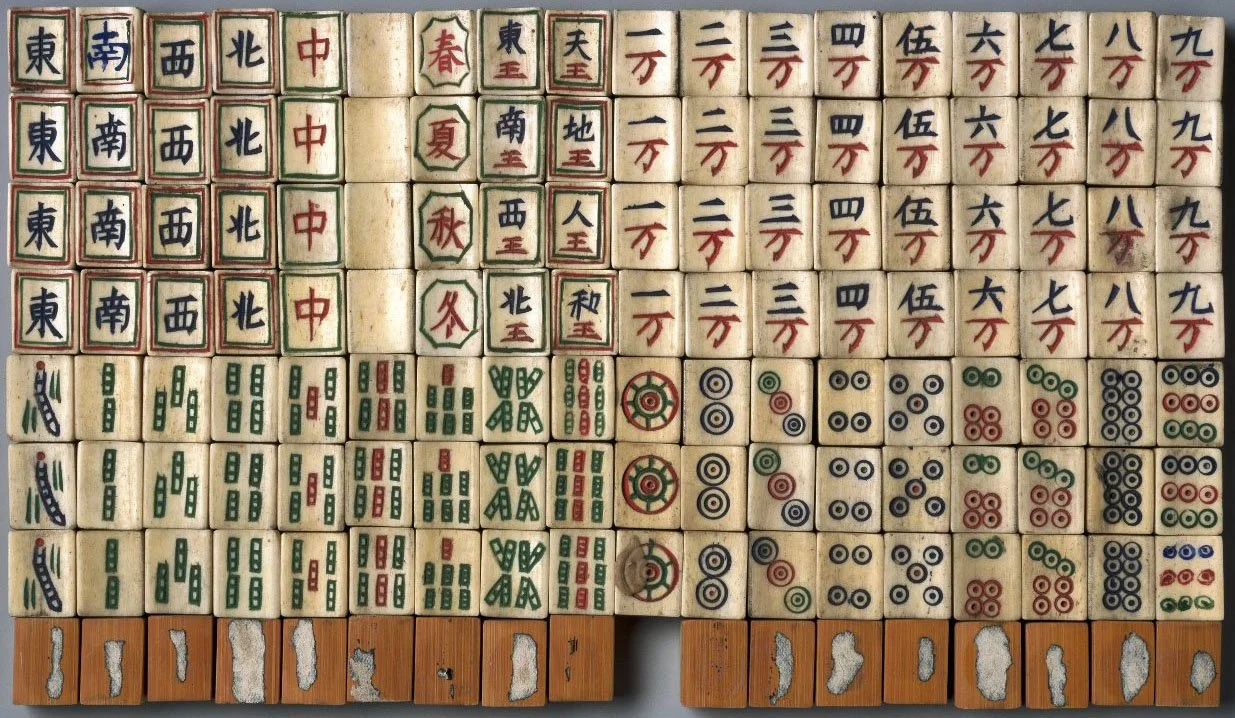
Early mahjong sets were often made from bone and bamboo, with symbols carved or painted onto the tiles. The name “mahjong” is commonly associated with the Chinese word máquè, meaning “sparrow.” One explanation for the name’s origin is that the clicking and clacking of tiles being shuffled together was reminiscent of a flock of sparrows chattering.
By the early 20th century, mahjong had become popular across different levels of Chinese society. The game’s combination of luck, strategy and social interaction helped it spread quickly across China. Restrictions were occasionally placed on the game because of its association with gambling, although it remained popular, particularly during holidays such as Chinese New Year. Mahjong was formally banned during China's Cultural Revolution from 1966 to 1976. After that period, mahjong returned to public life and once again became a familiar part of recreation and family gatherings.
Mahjong eventually traveled beyond China through trade, travel and migration. Today, dozens of forms of mahjong are played around the world including Japanese riichi mahjong and numerous regional styles across Southeast Asia.
Mahjong remains deeply woven into social life in China while continuing to attract new generations of players around the world, with recent surges in popularity in places such as India and the UK.
Mahjong Comes to America
Mahjong reached the United States around 1920. Joseph P. Babcock, an American businessman who encountered the game in China, published English-language rules that helped introduce mahjong to a broader American audience. Although the initial American mahjong craze of the 1920s faded, the game found lasting homes within several communities. It continued to be played within Chinese American families and became particularly important among Jewish American women who eventually founded the National Mah Jongg League in 1937. American mahjong incorporated distinct features such as joker tiles and an annually changing card of winning hands.
A Game That Keeps Growing
Today, there is no single universal way to play mahjong. Each form has its own rules, scoring systems and traditions, but they all trace their history back to the game that emerged in China more than a century ago. Community Mahjong is grateful to be one small part of that continuing story. Our tile collections may feature new artwork, but the mahjong table has always been a place to gather, compete and connect.
Pull up a chair, shuffle the tiles, and let’s keep the tradition going! There’s a seat waiting for you.
Think You Know Your Mahjong?
You’ve learned the story. Now test your knowledge! Score 5 out of 5 to unlock 15% off your first Community Mahjong order.